Back in 2008, a young 1st term senator from Illinois came out of nowhere in the span of two years to win the election for President of the United States. For many, this sudden rise seemed incomprehensible. How could Obama, an African American, have captured 70 percent of the vote from people under the age of 25? For those who were “in the know” about social media, however, this was no surprise. Obama had beaten McCain on the internet. Obama had over 2 million Facebook followers to McCain’s 600,000. Obama’s youtube video channel had garnered 97 million video views, while McCain only achieved 25 million. For this reason, the 2008 presidential election began to be known as “The Facebook Election.” For the first time, social media were seen as more than just an interesting diversion or as entertainment. The 2008 election gave legitimacy to the power of social media technology to significantly change the world. After all, one of Obama’s lead political strategists in the election was Facebook co-founder Chris Hughes. The strength of social media clearly has extended to the political realm.
 |
| Obama, checking his status as the web's premiere political overlord. |
The technological realm of social media will likely be an even bigger battleground for the upcoming 2012 presidential election. Even the Republican primary may be won by the candidate who can emerge from the field with a strong support among younger/technophiles. In 2008 (according to PEW), during the “Facebook election” only 46 percent of Americans used the internet, email, or texts to get political information. By 2010, 58 percent of American adults used the internet for news about politics or the 2010 elections. One can only imagine how much that number will have increased by November 2012.
Political candidates are already making moves on the internet for the 2012 election. Barack Obama’s Facebook and Twitter pages, this past June, made a transition to their “election modes.” His pages are now being controlled by his 2012 campaign team, and there are easily accessible places to donate to Obama’s ever growing campaign fund. Obama recently released the information that he had raised 86 million dollars last quarter. The money came from 552,462 different people, for about 150 dollars per person. This leads me to believe that much of Obama’s money is coming from small donations, and Facebook provides an excellent access point to send in that money. Even Joe Biden is getting in on the act. While Obama has over 22 million Facebook followers, Biden still pulls in a solid 300,000. His Facebook page was just recently revamped as well. His wall features no posts from 2008 until this past Friday. The page will now also be run by the Obama-Biden campaign staff and will feature updates on what the VP is up to in the political world these days. Biden also recently has joined twitter where Obama already has 8.6 million followers.
 |
| Apparently, these hip sunglasses weren't enough for Biden to be relevant to America's youth (at least according to his campaign managers). |
The Republicans, for the moment, are lagging behind. Palin, still not a declared candidate, leads the way with Facebook page likes (3.1 million) and Twitter followers (565,000) according to an ABC News blog. But, as a result of the Facebook election, Republicans hope to work harder this time around to at least lessen the democratic party’s social media advantage. ABC News wrote that, of the top 10 candidates from the 2010 elections in number of Facebook page likes, 8 of these candidates were Republicans. Of course, the Republicans gained great ground in Congress in those elections, but can they really challenge Obama’s vice grip on the medium? On July 20th, the Tea-Party will make a huge statement. They will be hosting their first presidential debate and it will take place over Twitter.
The debate is an excellent strategic move. All those who want to follow the debate, even if they are not truly backing any Tea Party Candidate at this time, will need “follow” these candidates on Twitter. The Tea Party can then hope that these followers will “stay on board” so to speak, and will offer a new set of voters to whom these candidates can spread their ideas.
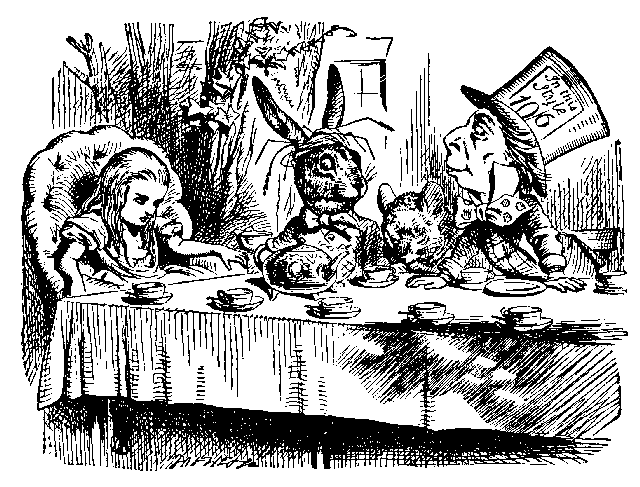 |
| Michele Bachmann, left, checking her Twitter in perparation for her debate with the Mad Hatter and the March Hare. |
Still, it is unlikely that Obama, who has been building a Facebook army for 5 years, will be caught. Republicans cannot expect to catch Obama, but they must make it a fair fight. Without increased presence on social media, Obama will be able to maintain his virtual monopoly on the ability to reach a large number of voters with immediate information.
The only question that remains, is will followers translate directly into votes? We saw that this was the case in 2008 and 2010. 2012 remains a mystery.

My biggest problem with your blog (which I found to be hilarious and creative) is correlation does not ultimately lead to causation. One stat you referenced to one your blog 70% of people under 25 voted for Obama. You then make an inference that Obama got that high a percentage of votes from the younger generation because he was more popular than his Republican counter-parts on the Internet and social media sites. This is a relatively valid point, but not entirely accurate. It is generally known that younger people typically vote for Democrats (go to any college campus and this assumption can be made valid). Additionally, at the time, younger people were the ones on social media sites. This is not a group of individuals that Republicans are most interested due to my first point (they usually vote Democrat anyways). However, as more people (generally older) are going on to these sites, I agree with you that both sides need to make a more concentrated effort to garner attention from social media sites, such as Facebook and Twitter.
ReplyDeleteVery good point Alex. Correlation does not lead to causation. But, I'm pretty sure correlation is correlated with causation. You're right that the Republicans probably aren't banking on the young vote, but they could at least gain some ground on it with advances in social media.
ReplyDeleteI really enjoyed this post, and especially your exploration of the rise of social networking-based donations. One of the major advantages of social networking is definitely its ability to increase access to and the visibility of smaller, less known candidates. As you pointed out, while we might not see this in 2012, we definitely saw it in 2008 and most certainly will again in 2016. The only potential downside of this, however is the tendency of candidates to dumb down their message for the online medium – so whether the increased reliance of political campaigns on Facebook and Twitter is a good thing remains to be seen.
ReplyDelete-Shashwat