One week ago, Alyssa Campanella of California was crowned Miss USA. The pageant is well known for its interviews in which each candidate is asked a serious of relevant political or social questions. This year, one of these questions was whether evolution should be taught in schools. While many of the young women stated that evolution should be taught in schools, very few of these women were in complete favor of evolution (shout out to Miss California and to Miss Vermont who called it a scientific fact). The rest of the women were more like Miss Maine who stated that both evolution and faith (a.k.a. “both sides”) should be taught in schools, and students should be given the right to choose which idea they want to study.
While it may be somewhat of a relief that the winner of the pageant believed in evolution and “the big bang theory,” I cannot help but be disturbed by the simple lack of scientific understanding of so many of these young Americans. One of the more troubling responses came from Miss Kentucky who said it should not be taught in schools because, among other reasons, “scientists have their different theories.” This is simply wrong. Not teaching evolution is equivalent to not teaching gravity, after all both are theories.
The women mostly fell back into this usual “evolution is only a theory” argument, meaning that it is not worthy of full merit of consideration. This belief ultimately comes from a misunderstanding of what science means by theory.
According to the American Association for the Advancement of Science:
“A scientific theory is a well-substantiated explanation of some aspect of the natural world, based on a body of facts that have been repeatedly confirmed through observation and experiment. Such fact-supported theories are not "guesses" but reliable accounts of the real world. The theory of biological evolution is more than "just a theory." It is as factual an explanation of the universe as the atomic theory of matter or the germ theory of disease. Our understanding of gravity is still a work in progress. But the phenomenon of gravity, like evolution, is an accepted fact.”
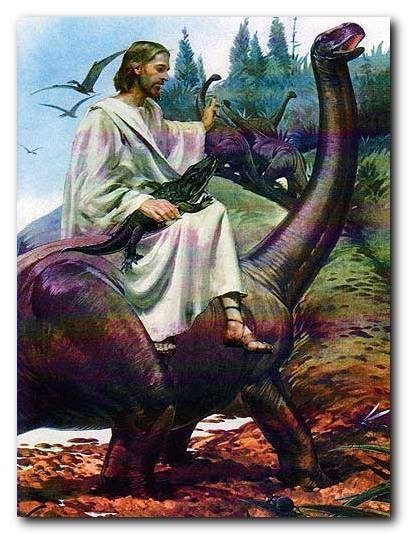 |
| "The Land Before Time 17" starring Jesus |
These women—whether they truly misunderstand, or simply were trying not to upset an American population that misunderstands—did not have a grasp of this basic scientific concept. Furthermore, they misunderstood evolution itself (likely because some of them have never been taught it in the first place). Their answers seem to show that they “confused evolution of species with the origin of life.” Evolution is a process by which species change. It says nothing about whether or not God created life or the Earth or the Big Bang or anything. The bottom line is that evolution exists and is not at all somebody’s “imagination” like Miss Washington says.
-------------------------------------------------------------------------------
So where did this great miscommunication come from? Why do all these women so openly shirk science in front of a national audience? Is America really doing this poorly at educating its youth?
The most ardent naysayers will likely never accept evolution. But if America as a whole was more open and accepting of science, perhaps such displays as this Miss USA Q&A debacle would be more upsetting to our nation’s populace. As Nisbet writes in his article (“What’s Next for Science Communication?”) much of this problem comes from the way some scientists frame science and religion. One prominent biologist, Richard Dawkins, argues that science and religion are incompatible. If this viewpoint is taken, all religious people begin to see science as their enemy. Instead of this approach, scientists must not view religion as the enemy, just as something entirely different, not as science’s rival in the power of explanation.
 |
| For most children, a museum trip is roughly the same as an elevator ride. Buttons!!! |
Four years ago, I worked as a volunteer at the Chicago Field Museum of Natural History. One aspect of my job involved using an electronic board to tell people about the many plants and animals that originated in ancient North and South America. I soon found out that the majority of guests had no interest in my explanation, and had far more interest in pushing the many buttons on the electronic display to make all of the lights flash at the same time. Does this mean that “real” museums are useless for teaching science and that virtual museums would be better? No, I wouldn’t say that. But we must realize that, for much of the population, science and museums represent a sort of interesting diversion, but not real truth. Dinosaur bones are big and neat to look at, but most people neglect to understand the evolutionary implications that they should be grasping when observing these ancient behemoths. Unfortunately, many people see science only in this sense of museum-like “wonder” because religion already occupies the position of primary world explainer in their minds. If teachers wish to engage religious youths with the possibilities of science, they must show that there is room for the two to coexist. Religion, in fact, could be the tool used to explain the laws of science (isn’t it possible God created evolution?). Hopefully, in time, we will have fewer people that think belief in science is at all related to moral values (Miss Idaho) and more people that are self-proclaimed science-geeks like our new Miss USA.

I really enjoyed reading your blog post! It was filled with questions and filled with open-ended answers. These debates about what should be taught in school are probably the most common but I think its interesting how that plays into peoples "understandings." Let me explain, decades ago I believe most of these women would have said that both should be taught and let the children decide on what they want to learn, but I'm sure that an answer such as "Its scientific fact" would have caused a contestant a guaranteed loss. I think this post touch on how we as a people are "evolving" our beliefs from the typical "Religion is the answer" to "Evolution is scientific fact!" This change is what s important and to ask our selves why. Now I'm not saying that I am pro scientific theory and "fact" because I am a very religious man, but I think its interesting to see how people have become less religious over time and more "worldly." This blog post captured my attention in a few ways more than one, but that little internal argument had me captivated!
ReplyDelete